
5% OFF WITH THE WELCOME CODE

THE SWEET WINES

To obtain sweet wines with a significant residual sugar, it is possible to block the fermentation by preventing the yeasts transforming the whole sugar into alcohol. Methods for blocking fermentations usually include microfiltrations that hold residual yeasts. In this way it is avoided that with the arrival of the first warm yeasts resume their activity and transform the residual sugar into alcohol. Among the most famous sweet wines in Italy they have the Asti sparkling wine and Moscato d'Asti obtained from Moscato grapes, and the Brachetto produced with the red grapes of Brachetto. In order to produce passive wines, we must ensure that the grapes contain more sugar than the one normally found. The simplest procedure is late overcrowding or harvest, which is to delay the grape harvest by about 10/20 days so that the grapes accumulate more sugar in the order of 20/25% more. This method is useful for those acids rich in acidity, intended to produce sweet or sweet wines with a modest residual sugar. Another method is that used to obtain the famous Eiswein, ice wines produced in Germany, Austria, Canada and Valle d'Aosta. The grapes are left on the plant and harvested in January, when the clusters are wrapped in frozen ice, while the water inside the grapes has frozen. During crushing, icy water is eliminated and the resulting must is rich in sugars and aromatic substances. When autumn is hot and humid and usually we are close to currents or in continental continental winds, there is the possibility that the grapes will be attacked by what is called a noble mold, which, unlike what can be done after the rain will not break the grape but it will grow in the form of a rash and will gently wrap the grape juice.The noble mold dries the grapes, favoring evaporation of water, concentrating the juice and sugars, which in the wine will result in the formation of particular aromatic compounds. The best wines are produced in France, in the Sauternes district with the grapes of Semillion, Sauvignon and Muscadelle, in Germany with the Riesling grapes with which the famous Beeremauslese and trokenbeerenauslese are obtained, and also in Italy in the border area between the " Umbria and Lazio. In the northern Italian areas, where the climate is milder, the bunches will be harvested for perfect ripening, when the water is completely evaporated and the sugar has reached high concentrations. Harvested grapes will be brought to special places, called fruity, where they will be left to dry. This technique produces the Reciotti of Soave and Valpolicella, the Vin Santo of Trentino from Nosiola grapes, the Vin de Paille and Muscat in France, and the only two dried dry wines that are the Sfurzat of the Valtellina and the Amarone. In Tuscany it produces Vin Santo with Trebbiano Toscano and Malvasia Bianca, and Sangoivese for the version of Pear Eye. In the southern regions, the grapes are left to dry in the sun, which with its heat tends to alter the structure of the polyphenols that confer to the wine passed typical aromas of dried fruit, candied citrus fruits and Mediterranean scrub. This is how Malvasia delle Lipari, the Moscato Passito of Pantelleria and other wines in Greece, such as Moscato di Samos, Spain and Portugal, see Moscato di Setubal.

SKU: DTU005

The Macvin du Jura by Domaine de la Tournelle is the classic fortified wine from the Jura, produced from Chardonnay grapes to which Marc du Jura is added, the area's spirit traditionally aged for around 24 months in barrels. During fermentation this brandy is added to block it and leave a natural sugar residue. The Macvin du Jura by Domaine de la Tournelle is a truly niche product, which is aged for up to 7 years in wooden barrels. On the nose it has aromas of figs, ripe pear, plum, but also reminiscent of walnuts and raisins, a high alcohol content and a generous residual sugar accompany everything. It is a perfect wine to conclude a lunch or dinner, but also as an aperitif.

Region: France, Jura.

Grapes: Chardonnay

Alcohol content: 17%.

Aging: Up to 84 months in tonneau.

Contains sulfites
 

€67.00
Add to cart
SKU: MAS005

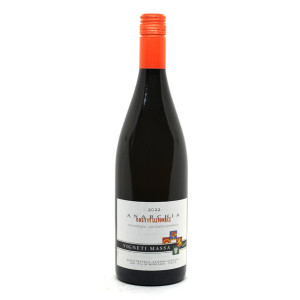
Anarchia Constitutionale by Massa is a partially fermented grape must based on white grapes that proves sweet and with low alcohol content. The selection of the grapes takes place in the first ten days of September. Maceration of the same and subsequent pressing; after 12 hours inactivation of the spontaneous fermentation phase by refrigeration and filtration. Constitutional Anarchy is straw yellow in color with a fresh nose of floral and fruity aromas. The taste is soft, fresh and aromatic.

Grapes: Local white grapes.

Alcohol content: 5%.

Aging: Some months in steel.

Contains sulfites

€15.90
Add to cart
SKU: FRK022

Alsace AOC Pinot Gris Vendage Tardive by Pierre Frick is an elegant white wine with a sugar residue of 46 g / l. Spontaneous vinification, aging for 10 months in old oak barrels. Unfiltered before being bottled.

Region: Francia, Alsazia.

Grapes: Pinot gris.

Alcohol content: 13%.

Aging: 10 months in old oak barrels.

Contains solfitus

€55.90
Add to cart
Compare (0 items) My Wishlist (0 items) Contact us
Please login first
Please login first

Your cart

There are no more items in your cart